About Accelerometer Sensor
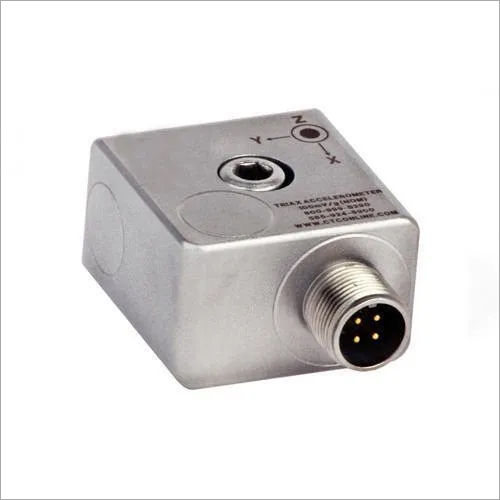
An Accelerometer Sensor possesses the capacity to convert physical acceleration picked up by movement or gravity into a voltage output. Accelerometers are frequently used to measure the dynamic acceleration caused by animal movement, the low-frequency acceleration module, and the inert acceleration caused by gravity. In simple words, it is a tool that monitors changes in the gravitational acceleration of the object it may be implanted in. Accelerometer Sensor is made up of multiple axes, with two determining the majority of movement in two dimensions and a third axes being available for 3D positioning.
| Accelerometer Type |
MEMS DC |
| Output Type |
Analog |
| Number of Axes |
3 |
| Sensing Axis |
XYZ |
| Acceleration Range |
+/- 60 g |
| Sensitivity |
10 mV/g |
| Operating Temperature Range |
-40 to +85 deg C |
| Output Voltage |
18 to 30 V DC |
| Excitation Voltage |
3-5 V DC |
| Brand |
MSI |
Robust Design for Demanding EnvironmentsWith a durable stainless steel, hermetically sealed housing and IP65 protection, the sensor resists corrosion, dust, and water ingress. Its ability to handle shock up to 5000g makes it suitable for heavy-duty machinery, minimizing risk of sensor failure in tough situations.
Integrated Signal Conditioning and AccuracyFactory-calibrated electronics deliver consistent sensitivity and high measurement accuracy. The integrated signal conditioning simplifies installation and setup, ensuring reliable analog voltage output for monitoring and analysis.
Flexible Mounting and ConnectivityThe sensor features a 4-pin M12 (or similar) industrial connector for secure and straightforward electrical integration. Customizable cable lengths and options for stud or bolt mounting allow it to adapt easily to diverse machinery layouts.
FAQ's of Accelerometer Sensor:
Q: How do I install the accelerometer sensor on industrial equipment?
A: The sensor can be mounted using a stud or bolt mount onto the machinery surface. Ensure the mounting area is clean and use the provided 4-pin circular connector to establish a reliable electrical connection. Follow all manufacturer guidelines for optimal performance.
Q: What are the main advantages of using this accelerometer sensor for vibration monitoring?
A: This sensor offers high accuracy, rapid response times, and a wide frequency range (2 Hz to 10 kHz) for effective monitoring. Its rugged, stainless steel design ensures longevity, while factory calibration provides plug-and-play reliability for critical industrial applications.
Q: Where can I use this sensor, and what industries benefit most?
A: This sensor is ideal for industrial environments where continuous vibration monitoring is essential, such as manufacturing plants, heavy machinery, and condition monitoring within various engineering sectors.
Q: What is the process for connecting the sensor to my monitoring system?
A: Simply connect the 4-pin circular industrial connector (M12 or similar) to your system's compatible port. The sensor outputs analog voltage, such as 4-20mA, as indicated in the datasheet. Ensure the voltage supply is within 3-5V DC for proper operation.
Q: When is recalibration necessary for this sensor?
A: As the sensor is factory calibrated, recalibration is not required under normal operating conditions. However, periodic verification may be recommended depending on your industry's maintenance schedule or if the sensor has experienced extreme events.
Q: What are the benefits of the sensor's ingress protection and shock resistance?
A: With an IP65 rating and shock limit up to 5000g, the sensor reliably operates in harsh, dusty, or wet conditions. This robust construction reduces downtime and maintenance, ensuring consistent performance over a long lifespan.








 Send Inquiry

 Send Inquiry
 Send Inquiry
 Send SMS
 Call Me Free


 English
 Spanish
 French
 German
 Italian
 Chinese (Simplified)
 Japanese
 Korean
 Arabic
 Portuguese